
What is DISC? A Quick Definition
DISC is a behavioral assessment model pioneered by psychologist William Moulton Marston in the 1920s. It classifies people into four behavioral styles: Dominance (D), Influence (I), Steadiness (S), and Conscientiousness (C). It represents how you naturally respond to events, other people, and your natural work styles. The DISC framework empowers teamwork, conflict resolution, and improved communication.
The Four DISC Personality Styles
While everyone shows traits from all four dimensions of behavior, people have a primary and a second DISC style. As Dr. John T. Cocoris’s research shows, your first and second DISC personality styles create 12 core behavior patterns.
These patterns shape how you act and reveal key motivators, preferred work styles, and natural communication patterns.
People often think of this as four DISC personality types; however, this is not entirely accurate. The four DISC personality styles describe four groups of traits. Each group has over 100 traits that each person has from low to high.
An overview of the Four DISC Styles are summarized below:

Dominance (D) – The Results-Oriented Driver: Brief, direct, and to the point. Decisive, confident, and focused on bottom-line results.
The D behavioral style, sometimes known as a High D, is active, fast-paced, and task-oriented. Driven by results, their primary behavioral need is to overcome challenges, achieve goals, and get results.
Under stress, Ds can become blunt or overly demanding. Discover more traits of the D-personality.

Influence (I) – The People-Oriented Socializer: Natural smile and likes to talk. Social, playful, active. They excel at motivating others.
The I behavioral style, also known as the High I, is fast-paced, highly verbal, and people-oriented. Driven by enthusiasm and social connection, their primary need is group involvement and positive interaction. The I can persuade others with their outgoing personality.
Without restraint, High I tendencies may lead to being disorganized or excessive talking. Explore the full traits of the I-personality.

Steadiness (S) – The Service-Oriented Helper: Steadfast and routine. Driven by stability, they are Loyal team players who reliably support others.
The S behavioral style, historically known as High S, is deliberate, calm, and service-oriented. Their primary need is a conflict-free, secure environment with minimal change.
The S is resistant to change, especially sudden change. Under pressure, High Ss may fail to comply with requests to change their routine. Learn about the traits of the S-personality.

Conscientiousness (C) – The Quality-Oriented Analyst: Analytical and organized. Likes to plan and needs time to think. Their primary goal is maintaining accuracy and high-quality standards.
The C behavioral style, sometimes known as the High C, is cautious, systematic, and task-oriented. They rely on facts, logic, and structured processes to solve problems. High Cs pay close attention to details.
When under stress, High Cs may overanalyze. Read about the analytical C-personality.
DISC Analysis: The Complete Method
A professional DISC analysis is a simple, smart assessment that maps how you naturally behave.
While many people think of DISC as just a quick online test, a true assessment goes deeper. It shows how you respond to challenges and communicate with others. It reveals your working styles and what you need most to feel happy and successful.
The DISC Strengths assessment is an online analysis of your four DISC styles. The assessment identifies your primary and secondary styles, which combine to create your behavioral pattern, or “combination.” Your DISC pattern guides 70 to 80 percent of your daily choices. It also represents your natural “comfort zone”—the way you act when you are relaxed and just being yourself.
But what about the other two styles?
While your top two styles are the loudest voices in your personality, a full DISC analysis also looks at your third and fourth styles. Even though they are in “last place,” these lower traits still have a major hidden impact on how you act.
Think of your third style as your “hidden backup helper.” It is not active all the time, but it is a resource you can tap into when you need it.
For example, in some combinations, the active D-style in the third position serves as a hidden backup. It helps you stay direct and get fast results when problems arise. If Steadiness (S) is your third trait, it works as a built-in softener. It gives you patience and warmth. This helps you stay calm and connect with others.
Your fourth style represents your lowest trait, which could be your “blind spot.” It reveals behaviors that may not come naturally to you.
For example, if Steadiness (S) is in your fourth spot, you lack a natural desire for routine. This means you might get bored easily, act impulsively, or struggle to stay organized.
If Dominance (D) is your lowest trait, you may find it hard to speak up. You may also avoid confronting others when they upset you.
Correctly identifying your third and fourth styles is valuable. It highlights where you can practice and strengthen the positive traits of each style.
Dr. John T. Cocoris pioneered an assessment and validation process to separate temporary behaviors from true, inborn traits. This complete method uses four key steps:

The Assessment Questionnaire:
Respondents complete a structured, dynamic questionnaire that measures behavioral responses across varied scenarios.

Multi-Graph Scoring:
We evaluate responses for adapted social behavior, behavior under pressure, and natural behavior. This helps identify true DISC or temperament comfort zones.

Evaluating Blends:
Primary styles offer a high-level view. A complete analysis recognizes that people show a blend of traits from all four DISC styles. These blends include D-I, D-S, D-C, I-D, I-S, I-C, S-D, S-I, S-C, C-D, C-I, and C-S. This blend shapes overall expression.

Validation:
Reviewing detailed profile results with a qualified practitioner or coach helps people interpret profiles accurately. It also helps them understand how people express traits. No two people are fully alike. Still, we share DISC traits.
The History of DISC
Understanding the history of DISC involves tracing its development from early psychological theories to contemporary behavioral research:

William Moulton Marston (1928): The foundational breakthrough happened when psychologist William Marston published his book, Emotions of Normal People. He showed that human behavior depends on how we react to our surroundings. He found that we act either actively or passively. It depends on whether our environment is friendly or unfriendly. To explain this, he coined four core terms: Dominance (D), Inducement (I), Submission (S), and Compliance (C). (Note: Over time, other researchers changed “Inducement” to “Influence.” They also changed “Submission” to “Steadiness” and “Compliance” to “Conscientiousness” to create the modern DISC test.)

Walter V. Clarke (1948-1956): Industrial psychologist Walter Clarke constructed the initial self-assessment checklists to operationalize Marston’s four behavioral factors. Having noticed high turnover rates in department store jobs, Walter Clarke developed the Activity Vector Analysis (AVA). An assessment tool designed to evaluate job candidates and place employees in roles that best suited their behavioral tendencies.

Dr. John Geier (1972): Dr. Geier created early self-report profile tools based on Marston and Clarke’s work. He also coined the well-known DISC acronym.

Dr. John T. Cocoris (1977–Present): Dr. Cocoris greatly advanced DISC methods. He developed the DISC II and DISC Strengths assessments and reports. His work introduced key concepts in DISC blends, proximity dynamics, and validation.
It helps distinguish natural patterns from learned or adaptive behavior. Creating practical applications for personal and leadership development, coaching, and team building.
How the DISC Model Works
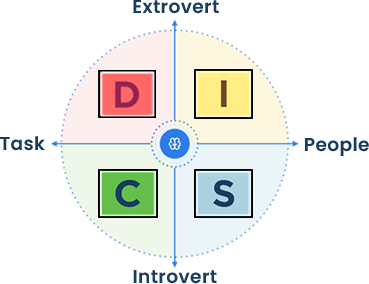
To understand how the DISC model works, it is helpful to look at the intersection of its core dimensions. The four DISC quadrants emerge from two primary axes:
a. Active styles (D and I) are fast-paced, assertive, and expressive.
b. Passive/deliberate styles (S and C) are slower-paced, thoughtful, and methodical.
a. Task-oriented styles include D and C. These styles focus on logic, efficiency, and results.
b. People-oriented styles (I and S) focus on relationships, communication, and team cohesion.
What is a DISC Profile?
When looking for an assessment, many people search for their “DISC type.” However, Dr. John T. Cocoris clarifies that you are never just a single, rigid “type.” Instead, the model uses Four DISC Styles that represent over 100 distinct behavioral traits.
Your DISC profile is the personalized, detailed report generated by our assessment. While a “type” tries to place you in one broad, single-letter category, a true profile shows your mix. It includes all four styles. These styles reveal your blend and DISC Pattern.
Our online assessment measures your score in each of the four styles. It ranks them from your most prominent to your least prominent.
This specific arrangement of traits defines your unique blend. Because each person is unique, your “Personal Report” documents your style in a way that’s unique to you. Your report goes far beyond basic data. It uses a clear, common language to help you understand your natural DISC behavioral blend.
Inside your report, you will find an explanation of DISC and a full map of your strengths, needs, core fears, and blind spots.
Most importantly, it gives you practical, step-by-step tools. These tools help you identify your natural weak areas so you can make a plan to address them on your road to success.
The Benefits of Using DISC
Using the DISC model in your personal life and at work offers many wonderful benefits. By learning the four styles—Dominance, Influence, Steadiness, and Compliance—you can grow. You can improve relationships. You can build a stronger team.

Enhanced Self-Awareness:
First, DISC helps you answer the question, “Why do I do what I do?” It reveals your natural strengths and the weaknesses you might need to learn to control. Best of all, learning your DISC blend shows you that you are completely normal.
Your natural habits and ways of thinking are not weird, strange, or odd; they are just part of your unique, inborn design. This self-awareness brings a healthy level of self-acceptance.

Improved Communication:
Second, it improves how you talk to others. Everyone has different behavioral needs. When you stay flexible, you can change how you communicate. Do this to match each person or team member’s needs. Meeting their needs increases the likelihood they will respond positively.

Conflict Mitigation:
Third, DISC helps stop arguments before they start. Recognizing that people have different needs and styles helps you see them as different rather than intentionally difficult. They are simply different. This helps you handle behavioral differences fairly and objectively instead of taking them personally.

Team Dynamics Optimization:
Fourth, it helps teams work better together when each person’s role matches their natural tendencies. For example, giving detail-oriented tasks to a person with C first or second. Giving fast-paced, result-oriented tasks to a D. Routine tasks to an S and people-oriented work to an I. People are highly motivated and do their best work when their job matches their natural needs.

Leadership Effectiveness:
Finally, DISC equips leaders to be more effective. A leader can learn to adapt their management style to inspire or guide their workers properly. This keeps the team productive, supports a healthy environment, and helps prevent burnout.
Is DISC Scientifically Valid?
When people ask if the DISC model is truly accurate, we can look closely at the science and history behind it. For a personality test to be scientifically valid, it must measure what it claims each time. This requires checking its validity and reliability.
Modern DISC tools undergo rigorous studies to prove they are both accurate and reliable.
A great example of this scientific proof is the DISC II assessment, which laid the foundation for the modern DISC Strengths test.
In 2007, a research team at the University of Texas at Arlington ran independent scientific checks on the assessment. Dr. Marc C. Frame led the team in the Industrial and Organizational Psychology Laboratory.
They looked closely at how the test was built and whether the results held up over time. Their research found that Dr. John T. Cocoris’s work on the DISC II model is valid, reliable, and free of bias. This means anyone taking the test can trust the results.
Beyond this official university study, decades of real-world proof back the DISC model.
Dr. Cocoris has dedicated nearly fifty years to researching and testing human behavior, starting back in 1977.
He didn’t rely only on written tests to support his work. Instead, he traveled extensively and held thousands of one-on-one interviews with people from many walks of life. During these interviews, he asked specific questions to validate each person’s unique DISC blend. Because of all this real-world testing, the DISC Strengths results help everyday people.
Today, the DISC Strengths assessment uses proven science, validation, and nearly 50 years of interview research.
It brings it all into one simple platform. Its main goal is to provide a highly accurate and widely accessible online assessment that anyone can easily use.
How DISC Compares to Other Assessments
DISC is often evaluated alongside other popular behavioral tools, serving as an additional perspective. Rather than competing, people can gain benefit from these different models to understand human nature from complementary angles.
Myers-Briggs Type Indicator (MBTI)
The MBTI evaluates four internal cognitive preferences to group people into 16 distinct personality types. In contrast, the DISC model measures over 100 observable traits across four behavioral dimensions. This allows more flexibility and diversity in how people act.
Rather than competing, the two systems work beautifully together. MBTI reveals how people process information internally, while DISC demonstrates how those thoughts manifest in external workplace communication.
Additionally, DISC has strong, independent third-party testing for validity and reliability. This makes it a practical tool for day-to-day team building.
The Enneagram
The Enneagram assesses deep-seated emotional drivers and core fears, categorizing individuals into nine primary types. In contrast, DISC focuses on daily responses and behaviors across four main styles. It covers over 100 traits. It shows how people adapt and respond to different situations.
While the Enneagram can help you grow, DISC gives practical tips. It helps you understand yourself and work well with your team.
Third-party validity and reliability testing supports DISC and its everyday usefulness.
DISC Frequently Asked Questions
For more answers, visit our complete DISC FAQs page.
Ready to Discover Your DISC Profile?
Understanding the DISC model is the first step toward clearer communication and improved workplace relationships. Exploring your behavioral preferences offers valuable insights into your daily strengths, motivators, and communication tendencies. See what a DISC profile looks like to learn more about applying behavioral insights today.